AN AESTHETIC TAXONOMY
How do we measure learning in both creating art, and appreciating it?

This is rather specialized… likely of interest only to those who teach art creation and/or appreciation, or those interested in aesthetics generally. It first appeared in The Canadian Art Teacher, 18:2 (2022) and hasn’t had much response. Maybe it’s too theoretical for the artists, and too artsy for hardcore pedagogues. What do you think?
The learning taxonomies outlined by the original Bloom committee (1956) have been in use for more than half a century now. Krathwohl and Anderson (2001) updated the cognitive taxonomy, turning the original nouns into gerunds, putting Creating at the top and moving Evaluating to second-highest. The cognitive taxonomy, intended to distinguish levels of logical thinking from Remembering up, has been by far the most-used in education. It has influenced curriculum, pedagogy, evaluation and model route planning at many levels of education from primary to post-secondary.
The other two taxonomies, affective and psychomotor, were designed to help differentiate levels of accomplishment in, respectively, feelings, attitudes and values, and hands-on to whole-body physical activities. Instead of considering a redesign or updating of these, I suggest a different consideration. Did the framers of these taxonomies really address all the important domains of learning? If not, what did they leave out?
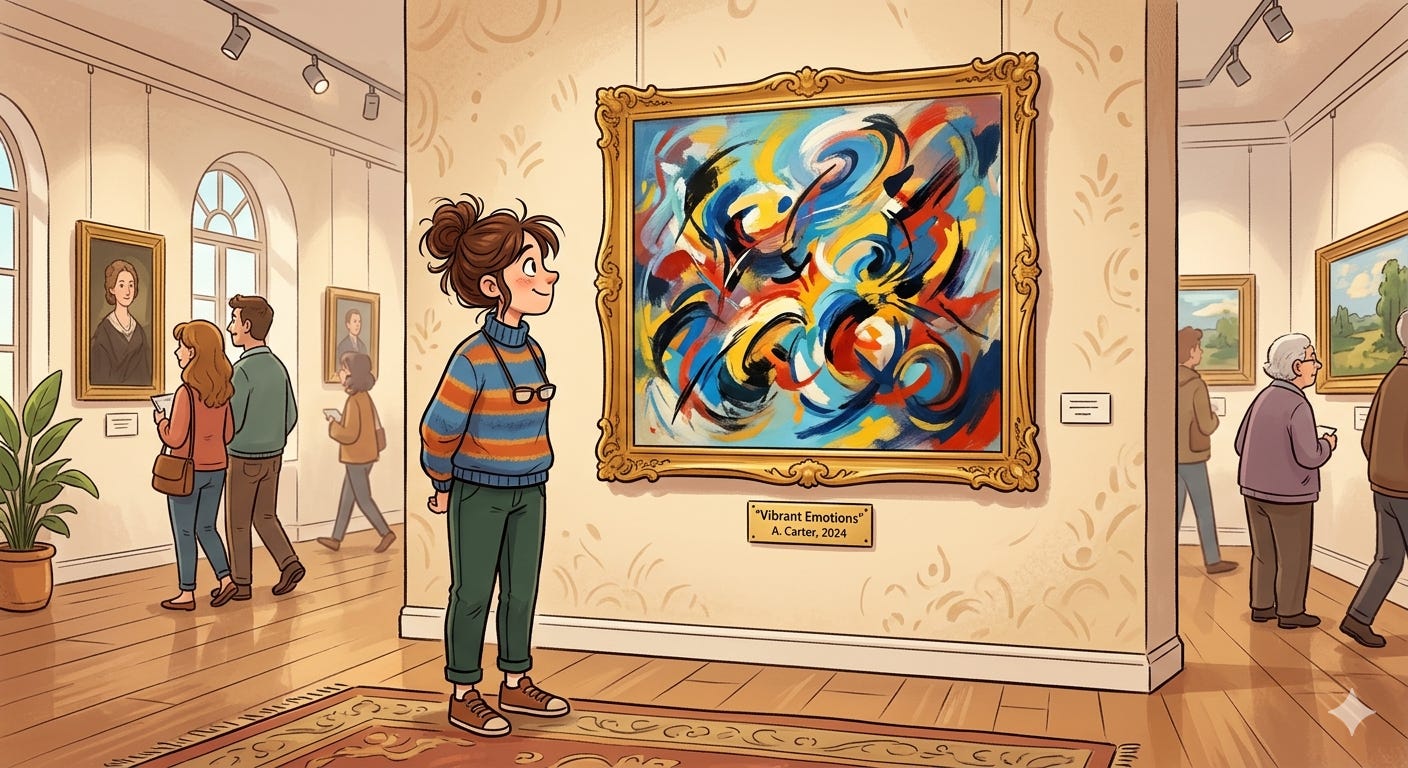
Image generated by Nano Banana
You may have a different answer, but I am going to nominate the aesthetic domain as one that merits more attention and its own taxonomy. Such a domain includes learning experiences with elements of all three of the Bloom’s taxonomies: cognitive, affective and embodied/bodily learning. I have seen a recent upsurge of interest in approaches that include aesthetic experience as part of a well-rounded education.
Specific approaches include arts-based inquiry, teaching creative process, arts integration, and ethno-drama. The increasing application of Gardner’s Multiple Intelligences theory to education has also inspired teachers to apply more holistic and, sometimes, aesthetic strategies to different subjects, including those under the STEM (Science, Engineering and Mathematics) umbrella. Sir Ken Robinson’s 2006 discussion, Do Schools Kill Creativity? is the most-watched TED Talk ever.
In an earlier age, aesthetics might have been defined as the study of beauty and harmony. The Romantic era added the notion of the Sublime, an experience that combines awe or fear with beauty. Many contemporary creative efforts – in visual arts, literature, music, dance, drama and film, even architecture – are not conventionally beautiful or harmonized. They confront traditional notions of what is beautiful or well made. In fact, when considering aesthetics, it is dangerous to ignore the fact that many “classical” or “generally accepted” ideas of beauty stem from limited, even biased, ways of thinking. “Rules of taste enforce structures of power,” said Susan Sontag.
When I discuss aesthetic productions or creations, my definition must therefore be general: a work or experience which uses aesthetic and genre conventions – whether it reinforces or questions them – to create an emotional experience for viewers or participants. “Any great art work … revives and readapts time and space, and the measure of its success is the extent to which it makes you an inhabitant of that world - the extent to which it invites you in and lets you breathe its strange, special air”, Leonard Bernstein wrote.
Programs that focus on turning students into artistic or creative professionals such as dancers, musicians, writers, actors, architects, and designers pay some attention to developing their aesthetic thinking. But I have not yet found a commonly-used taxonomy that works for planning and evaluating different levels of aesthetic knowing the way that Bloom’s cognitive taxonomy functions for the acquisition and use of facts, models, and theories. Some educators apply the cognitive taxonomy to students’ aesthetic learning; others rely on a more holistic or overall mode of thinking. Some use rubrics that are not tied to a taxonomy. This raises the question: what might an Aesthetic Domain taxonomy look like?
In suggesting a draft model for this, I am not relying on hard research. Rather, it is based on my own aesthetic growth as both a consumer and sometime reviewer of art, music, movies, dance, theatre, and many other creative productions, and as a poet, photographer and (eternal) guitar student. However, I am heartened by the fact that the Bloom committee’s domains and models were also not based on research, but rather on their experience as educators and evaluators of student learning.
As with their taxonomies, large assumptions underlie this model. One is that it is possible to note separate steps in what is often an intuitive, highly complex and looping process where knowledge, skills and experimentation have equal value. Another is that students should proceed through such steps in an orderly fashion to maximize their learning. That said, one strength of this model is that it applies both to learning experiences that foster aesthetic appreciation (such as survey courses of literature, art or music), and those that develop students as creative producers in their own right.
DRAFT TAXONOMY
As with Bloom’s and Krathwohl’s earlier taxonomies, the assumption is that the six levels of learning are not simply discrete activities involved in aesthetic knowing, but rather sequential and graduated performances which require a good acquaintance with the levels below them. You must first experience an aesthetic production in order to reflect on it or relate it to other experiences, and so on.
Lowest Level: Experiencing. Being part of the audience for a creative work or production
Second Lowest: Reflecting: Examining one’s own reactions to, and comprehension of, of the work experienced
Third Lowest: Relating: Finding and expressing correlations between the elements or overall effect of a creative work and other phenomena, such as the student’s own experience, history, cultural contexts, etc.
Middle: Analyzing: Distinguishing and commenting on the various themes, elements and choices that create an aesthetic experience
Second Highest: Critiquing: Evaluating the relative merit of these above elements and the overall quality of a creative production, and suggesting alternative strategies -- how something might work better using a different technique, context, etc.
Highest: Making: Conceiving, executing and sharing a creative work that gets an aesthetic reaction from others.
Thus, the taxonomy would look like this graphically. I welcome comments and criticism of this foray, and hope someone who teaches art for art appreciation actually applies it to an evaluation. If so, let me know if it worked well.